Internships

Whether you’re looking for an internship or a graduation project, or you’re wondering whether you could write your thesis at Van Oossanen Naval Architects BV, we’ll make all the expertise, experience and resources available that you’ll need to become one of the best in your field.

We’ve accumulated a wealth of expertise relating to hydrodynamics, computational fluid dynamics (CFD) and naval architecture – knowledge we gladly share with eager young graduate engineers as part of your professional development.

Van Oossanen has two internships available in:

  • Naval Architecture
  • Fluid Dynamics

As an intern, undergraduate or postgraduate, you’ll also play a key role on our research & development teams and projects, for example:

  • The application of sails as a means of propulsion for an 80m cargo vessel
  • Fully automated optimisation of the aft-body of ships by means of CFD
  • Development of a new fishing vessel concept for South-East Asia

Contact us if your study is related to the maritime industry or you are simply interested in the latests developments. 

Oh! And below a few testimonials from our most recent interns:
Testimonials
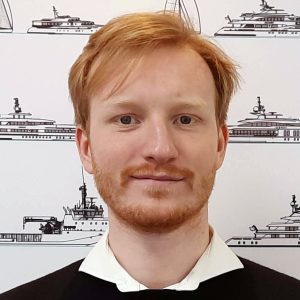
Lout Verschuur

Lout Verschuur

Growing up around small pleasure craft sparked a lasting interest in maritime technology, leading me to study Maritime Technology at NHL Stenden University. During the programme I became familiar with Van Oossanen’s work, making an internship there a natural next step.

The internship formed part of the MethaNorms project and focused on Wind Assisted Ship Propulsion (WASP), with emphasis on Flettner Rotors as a retrofit solution. The aim was to evaluate wind assistance improving hull efficiency and offsetting methanol’s energy density.

A key result was the development of a surrogate model that rapidly estimates Flettner Rotor forces using limited inputs, including geometry, flow conditions, and operational parameters. This enables early-stage feasibility assessments across ship types without costly simulations. The model was validated against in-house full-scale CFD data using a transparent workflow. The resulting tool supports decisions on when WASP delivers performance benefits, aligned with MethaNorms’ and Van Oossanen’s sustainability goals.

"Harnessing the wind: turning Flettner Rotor physics into real-world performance"
Alessandro Basso

Alessandro Basso

Driven by a deep interest in the transformative potential of Artificial Intelligence within the maritime sector, I chose to conclude my academic journey in Computer Engineering at the University of Genoa with an internship at Van Oossanen Naval Architects.

During my time at Van Oossanen, I played a role in the MENENS project, where I focused on the application of machine learning techniques to accelerate CFD simulations used to estimate water resistance. I also contributed to the development of optimisation algorithms aimed at supporting the early-stage design of high-performance yachts with a reduced environmental impact.

This hands-on experience allowed me to apply AI to real-world challenges in naval architecture, demonstrating the power of intelligent systems to enhance both sustainability and performance in the marine industry. My work highlighted the ongoing potential for innovation and improvement in this exciting field.

"When AI meets yacht design for a sustainable future!"
Ilona Hollander

ilona Hollander

The environment and sustainability have always been important topics for me. With more and more innovations coming to the maritime industry, my interest in smart solutions and the bigger picture they operate in only grows stronger. The yachting industry is a part of the maritime world were more resources for innovations are available, making it the perfect growing ground for solutions that are here to stay.

During my internship at Van Oossanen Naval Architects, I was able to combine my interests and this scientific approach is needed in order to assess and fairly compare different yachts, which will give better environmental insights for designers, yacht owners and others involved in the industry. Knowing the specific sources and amounts of pollution with their respective environmental impact is the first step in making better environmental friendly decisions where it matters the most.

“Dive into scientific ways to determine the environmental impact of yachts”
Lennard Bal

LENNARD BAL

With my background as a sailor in mind, I have always been particularly interested in yacht design and while studying Maritime Technology at the NHL Stenden University of Applied Sciences in Leeuwarden, I became more and more interested in the sustainability aspect. As Van Oossanen Naval Architects is one of the maritime companies at the leading edge of sustainability innovation when it comes to the application on yachts, I didn’t hesitate a second when an internship became available.

During the research on the application of timber as a more sustainable building material for yacht manufacturing, we have gained valuable insights in the potential advantages timber has to offer. This research has been quantified by various simulations before being able to compare its CO2 footprint to those of the more common building materials. This research is another step towards achieving the CO2 footprint reduction in yacht manufacturing the industry is aiming for in 2030.

“Another step towards achieving the CO2 footprint reduction”
Pim Hendriks

Pim Hendriks

Pim became interested in how certain vessel parameters influenced the overall design process while studying Maritime Engineering at the NHL Stenden University of Applied Sciences in Leeuwarden (NL). He subsequently secured an internship for his graduation project at Van Oossanen Naval Architects that allowed him to follow and investigate these interests in more detail.

His research led to greater control of a vessel’s structural weight and consequently the efficiency of the overall design process. The insights he gained into structural weights and centres of gravity helped improve not only the vessels’ performance but also project performance as a whole. Pim’s research is also paving the way to being able to automatically optimise a vessel’s structural weight!

"A vessel’s structure, weight and centre of gravity are paramount!"